
What you’ll learn
- Three shiny routes, each with its own roll
- A safe wild-hunting plan and practical ticket choices
- Duplicate rules, co-op rewards, saving and equipping
1. Choose between wild encounters, Rifts and gacha
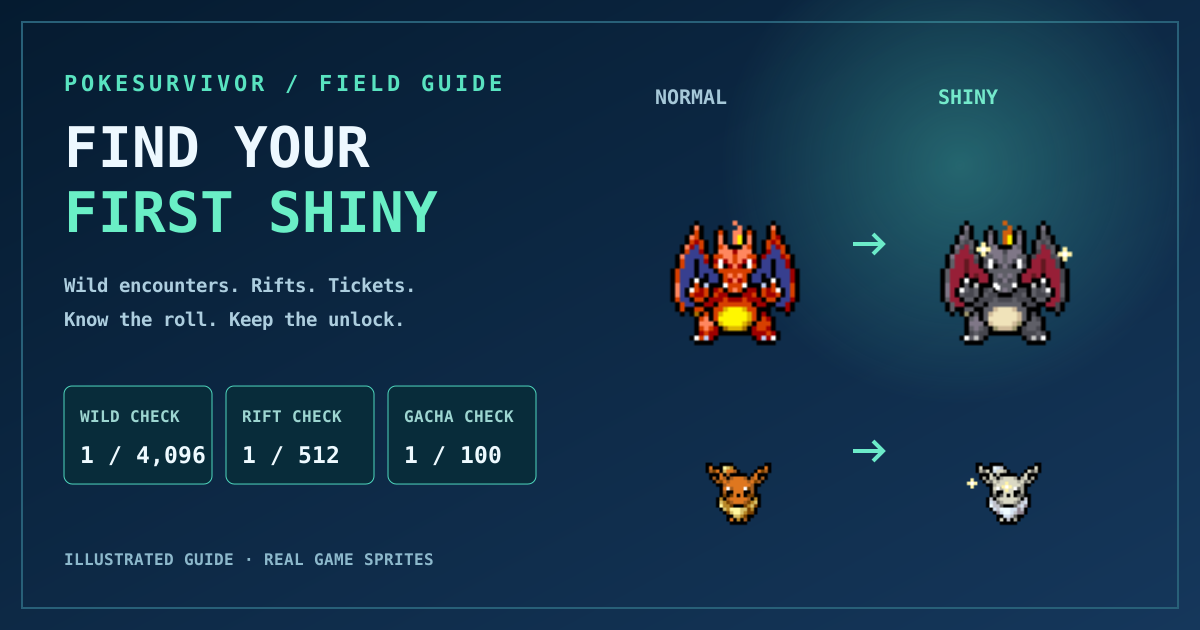
You can unlock a shiny by defeating a shiny enemy during a run, defeating a shiny legendary in a Rift or receiving a shiny result from a regional gacha banner. You do not need to own the normal form first: getting a new shiny also unlocks that species in its normal form.
If you want your first shiny of any species, combine ordinary runs with tickets earned along the way. If you want one favorite, first check its region and rarity. Neither route lets you name the next shiny that will appear, and a higher rarity does not make a result more likely to be shiny.
| Route | Shiny check | What you must do |
|---|---|---|
| Wild enemies | 1 in 4,096 per eligible spawn | Defeat the shiny enemy while staying alive. |
| Rift legendary | 1 in 512 per eligible legendary selection | Defeat the shiny legendary within the arena time limit. |
| Regional gacha | 1 in 100 after an eligible species is selected | Spend tickets in the correct region; inspect the result. |
2. How to catch a wild shiny
The shiny check happens when an eligible enemy spawns. Killing an ordinary enemy does not turn it shiny afterward. A shiny uses its alternate palette and sparkle effects; a shiny appearing through the regular enemy spawner also triggers an announcement and sound. Scheduled bosses can pass the shiny check too, so keep watching during boss fights.
The unlock happens when the shiny is defeated. Walking into it, seeing the announcement or collecting an unrelated item does not count. There is no separate Poké Ball interaction to perform in this capture flow.
- Start with a partner and main attack you can control comfortably. A hunt ends quickly if you cannot keep an escape lane open.
- When the alert appears, locate the sparkling enemy without crossing the center of the horde. Clear nearby threats if they block the route.
- Choose the active move that fits the distance and matchup. Keep attacking from a safe angle rather than standing on the target.
- Allow more time to finish it: the shiny enemy modifier doubles its HP and multiplies its XP by five relative to that enemy before the shiny modifier. Existing difficulty and boss scaling still apply.
- After defeating it, check the acquisition message, the run’s caught-shiny display and your collection. Before leaving or changing devices, press Save and confirm the upload status.
3. Hunt a legendary shiny inside a Rift
Rift legendaries use their own shiny check: 1 in 512 when the arena selects a legendary with shiny artwork. This is eight times the ordinary wild rate per eligible check. It does not mean eight times as many shinies per hour: Rifts appear far less often than regular enemies, and you still have to win the fight.
The opponent and its shiny form are selected when the arena starts. The roll does not repeat every second, whenever you attack or each time you switch moves. A normal legendary cannot turn shiny because you keep the fight going.
Defeat the shiny legendary to unlock its shiny and normal partner forms. Defeating an ordinary legendary records the victory for relevant goals, but does not directly give you that normal partner. An arena victory and ownership are different collection records.
Rift selection favors legendaries you have not defeated: their selection weight is 4, compared with 1 for a previously defeated opponent. That preference uses victory records, not your missing-shiny list. It neither guarantees the next species nor raises the selected legendary’s 1-in-512 shiny roll.
- Enter with enough health and damage for the arena, rather than treating its better per-check rate as a reason to risk every run.
- Read the arena’s terrain, weather and attack markers. You have 120 seconds to defeat its legendary; a shiny version has the usual shiny enemy HP modifier.
- Defeat the shiny before the arena fails and confirm its entry in your collection. Use Save and check its status before leaving or moving to another device.
4. Use tickets without confusing rarity and shininess
Open the game’s gacha and choose the region containing your target. A single pull costs one regular ticket. A ten-pull uses ten regular tickets or one ×10 ticket. Coins are not the currency used for those pulls.
The game chooses a rarity, then a species from that regional rarity pool, then checks whether that species has a shiny form. When it does, the normal shiny check is 1%. A species without a shiny form cannot become shiny through that check.
Ten-pulls guarantee at least one 4-star-or-higher result, not a shiny. Each regional banner also has a 5-star pity counter: from a counter of zero, the 70th pull is forced to 5-star if no earlier 5-star reset it. That rarity guarantee does not replace the shiny roll.
Do not read a featured portrait as a targeted shiny banner. For example, Pikachu is a 2-star Kanto partner, and the current Kanto pool has 41 species at that rarity. Before duplicate redirection, an ordinary non-guaranteed pull has a base shiny-Pikachu chance of 30% ÷ 41 × 1%, about 0.00732% (roughly 1 in 13,667). A ten-pull’s last-slot rule, pity and your existing shiny collection can change which result you ultimately receive.
- Stay on the target’s region if that is the partner you care about. Pulling a different region cannot directly select it.
- Use ten-pulls when you also value the rarity floor. They do not increase the 1% shiny check itself.
- A long dry streak does not create a hidden shiny guarantee. The displayed pity counter tracks 5-star rarity, not shinies.
5. What the odds mean over many attempts
A 1-in-100 check is not a promise of one shiny every 100 pulls. Independent attempts can produce an early shiny, several close together or a long stretch without one. The same reasoning applies to wild encounters: 4,096 eligible spawns do not guarantee a shiny.
The table models at least one successful shiny roll using 1 − (1 − p)^n. For wild rows, count eligible spawns, not kills or minutes. For Rift rows, count eligible legendary selections, not every enemy defeated in the arena. Gacha rows assume every selected species has shiny artwork. These are theoretical roll probabilities, not measured run results or the probability of a particular new shiny.
| Route | Eligible attempts | At least one successful check |
|---|---|---|
| Gacha | 10 | 9.56% |
| Gacha | 50 | 39.50% |
| Gacha | 100 | 63.40% |
| Gacha | 300 | 95.10% |
| Wild | 1,000 | 21.66% |
| Wild | 4,096 | 63.22% |
| Wild | 10,000 | 91.30% |
| Rift | 50 | 9.31% |
| Rift | 100 | 17.76% |
| Rift | 512 | 63.25% |
6. What happens if you already own the shiny?
Enemy captures and gacha results handle duplicates differently. Ordinary wild and Rift shinies share the enemy-defeat capture flow. This matters when deciding whether to chase a shiny you recognize or keep spending tickets in a nearly complete regional pool.
For gacha, the replacement search stays within the selected banner and rarity. It does not choose a missing shiny from another region or give you a free choice. If the first selected species has no shiny art, the game does not run this duplicate-redirection step to rescue the roll.
| Situation | Result |
|---|---|
| New wild or Rift shiny | Unlocks its shiny form and its normal form if missing. |
| Already-owned wild or Rift shiny | Adds 300 coins to the current run; no second collection copy. |
| Gacha rolls an already-owned shiny; alternatives remain | Selects a missing shiny from the same regional rarity pool. |
| Gacha rolls an already-owned shiny; that pool is complete | Falls back to normal. A new normal species unlocks; an owned normal uses its normal rarity refund. |
7. Compare the actual normal and shiny forms
The comparison below uses the game’s Idle animation frames and its original collection star effect. The game draws those stars separately from the shiny sprite sheet. Some palette changes are obvious; others are subtle. Check the Shiny label and collection status alongside the color.
These examples help you decide which partner to pursue. They are not a list of boosted-rate targets. Your preferred appearance does not change a banner’s probability.
Charizard


Eevee


Gengar


Lucario


Game sprites: SpriteCollab, CC BY-NC 4.0. Artwork credits and license →
8. Build a repeatable hunting routine
Start by choosing the goal: any first shiny, a specific partner or more missing forms in one region. Those are different projects. An encounter that helps a broad collection might do nothing for the one species you want.
For wild hunting, prioritize runs you can keep under control. Clear enemies efficiently and keep moving so you can respond when an alert appears. Do not reset a healthy run simply because no shiny appeared in the opening minutes; the next eligible check does not become better because the previous ones failed.
For gacha, earn tickets while working on useful missions and achievements. Check completed mission rewards and claim them in the game. Regular enemy drops, bosses and Rifts can also contribute tickets, but no fixed number of minutes guarantees a particular ticket or shiny reward.
If you target a species through encounters, remember that ordinary enemy casts and Rift opponents use different pools. A high kill count against other species is not the same as many chances at your favorite. For legendary shinies, count the Rifts that actually select a shiny-capable legendary; their 1-in-512 roll does not apply to all enemies in a run.
- Sign in, check your target’s region and compare the appearance you want.
- Choose a reliable survival build and one mission objective that fits it.
- React to wild shiny alerts safely, and take prepared Rift fights for legendary targets. Defeat the shiny before treating it as collected.
- Claim earned tickets, choose the intended regional banner and inspect your results.
- Confirm new entries, equip the desired form, press Save and wait until the game no longer shows pending progress.
9. Equip your shiny and protect the unlock
After an unlock, select that Pokémon in the official game’s collection. Its Normal/Shiny selector appears when you own the shiny form. Switch to Shiny and choose it as your partner. The main partner panel also has a Normal/Shiny control for an owned shiny, which is useful on mobile.
A shiny partner uses the same species stats and move pool. The extra HP and XP described earlier belong to shiny enemies; choosing a shiny appearance does not give your player double health or five times the experience.
A capture is recorded when the shiny is defeated; it does not wait for the run to end. With an account, that local record and a completed cloud upload are separate. Automatic uploads are scheduled after about 30 minutes with pending changes. Press Save at the top right, then wait for the pending status to clear before switching devices or closing. A recent upload can briefly delay another one. Guests do not keep permanent progress.
In the checked co-op flow, the host broadcasts the shiny-capture event to connected clients. It is a shared event rather than a final-hit contest. Stay connected and confirm the unlock in your own collection afterward; a teammate’s screenshot is not confirmation that your account saved it.
10. Shiny hunting questions
Can a Rift legendary be shiny?
Yes. Each eligible legendary selection has a separate 1-in-512 check. Defeat the shiny legendary to unlock it. Neither 512 attempts nor a normal legendary victory guarantees its shiny form.
Do I need a Poké Ball or a special capture item?
No separate capture item is used in the checked wild or Rift shiny flow. Defeat the shiny enemy; the unlock is granted by that defeat event.
Is a shiny guaranteed after 100 pulls?
No. At a constant 1% rate, 100 eligible independent checks give about a 63.40% chance of at least one successful shiny roll, before collection-related fallbacks. That is not a species guarantee.
Does the 70-pull pity make the result shiny?
No. That counter guarantees a 5-star rarity result. A separate shiny check still applies, and a 5-star resets that regional rarity counter.
Can I get a shiny before owning the normal Pokémon?
Yes. A newly granted shiny also unlocks the normal species if you did not own it.
Does Golden Hour, a stronger build or a long streak improve the rate?
The checked shiny rolls do not use those factors as rate bonuses. A stronger build can help you survive and finish an encounter; it does not turn the 1-in-4,096 spawn roll into better odds.
Why is there no Shiny button for my partner?
Check that you actually own that partner’s shiny form in the official game, rather than just its normal form or a preview on this site. A species also needs supported shiny art. Confirm you are signed into the same account that earned it.
Will I lose a captured shiny if I die afterward?
The unlock is triggered at the defeat, not awarded only for finishing a run. Keep the account signed in, press Save and confirm the upload status before leaving. A guest session or interrupted save is a separate persistence risk.
Rules checked · Game 7c1976458d. Report a correction →